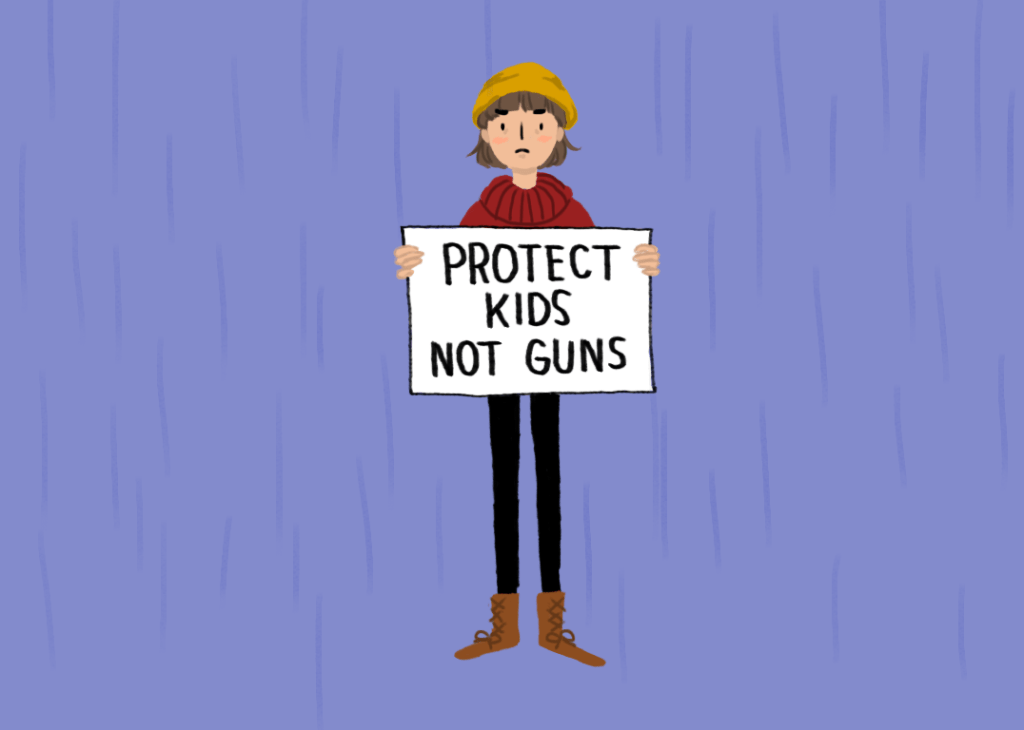
Should schools arm teachers and guards?

Habiba Ayman, ID:179933

Lately a hot debate ensues concerning whether teachers and security guards at schools should be armed or not. Some approve the concept and argue in defense of it in order to protect school students from any further accidents or fatal causalities, while others disapprove, and argue against because this breaks the image that the school is like home, and in a sense it has risks. Each argument is supported by reasons. A refutation is maintained to the first argument.

The first argument defends the concept of arming security guards and teachers by basing their argument on the analogy with banks and courts of laws. According to Heyitssal, there are armed security guards at banks to protect money, or to protect a small number of judges at courts. Children are the most valuable assets that deserve to be protected more than money. Secondly, this arming will prevent the further occurrences of accidents such as Columbine and Sandy Hook. Thirdly, schools cannot depend solely on seeking the help of police in case there is an assault, because the police will take minutes to arrive. In this time, there can be many deaths or injuries. Instead, if there are well trained security guards, they are already there at schools and can deal with the intruders at once. Fourthly, Juris Naturalis argues, if culprits realize the fact that schools are well armed, they will be discouraged to initiate an attack. Fifth, this provides the feeling of safety to the workers, teachers and students.

The counter argument holds that teachers and security guards are not professionally trained as policemen, therefore they can be irresponsible with the use of weapons, as Reni maintains. If one of the teachers or security guards has a violent temper, he can easily misuse the gun leading to fatal causalities. Also, beholding a teacher carrying a gun in the classroom creates an odd feeling in the psychology of the student regarding the mental concept of the school as a home substitute and the friendly and parental relationship between the teacher and student, because the child does not see the parent at home moving carrying a gun.

          According to Patricia Green, a child will come to school under the sensation that it is a prison, or a police station. Moreover, the security personnel are not badged as law enforcement officials. This poses extra danger . In addition, if a teacher enters the classroom carrying a gun, a student can find a way to take the gun and play with it.  Similarly, if the security guard is buddy with the student, he can allow students to hold the gun.

A refutation is maintained against the first argument. Wrike argues that it is preferable that police stations are located beside schools in order to be able to interfere as fast as possible whenever there is a threaten. Many organizations do not consent the very idea of arming a teacher. Also, the intruder has pre-planning prior the attack in order to induce the highest casualties . Logically, the first thing he will perform is to eliminate or paralyze the armed defender to prevent the latter from halting the assault.  That is, if a culprit intruder decides to cause harm, the security guard cannot stop him. Policemen are well trained enough to be able to deal with these circumstances. If there is an urgent need to arm schools, then it is enough to arm security guards , but arming the teachers is impractical and silly. Having armed security guards at schools is favorable from a safety perspective but can make the children feel uncomfortable and intimidated.   
Guns are life saving

By.Miriam ashraf 

191673

Worldwide many people protect themselves their family and shops but having a guns prevent thefts and bad people from doing awful things to victims . 

It’s foolish to talk about the privilege of self-protection in principle however then denying people the right to protect them because the police can’t or by the time they arrived the person has already been killed or robbed good people should be able to defend themselves and not just become victims because without guns they are defenseless how many of them can protect help themselves physical and even if they’re strong enough to defend themselves physically was will they do against a gun . yes guns does not ensure your life but it’s better than nothing yet on the planet would anybody not have any desire to have a way to ensure themselves and their families against criminal predators and maniacs? More regrettable yet, for what reason would anybody effectively campaign their administration to deny themselves and each other well behaved resident of the best way to ensure themselves safety . People should have guns to protect themselves from others who also might have guns do you expect for example an owner with a shop to have a baseball bat and the thief to have gun and owner will be able to protect himself of course not because there will shoot him in less than a second  self-preservation is one that can dependably, viably, and for all intents and purposes convey a proportionate measure of power in light of a risk of mischief. Firearms appear to plainly fulfill this portrayal. They don’t require extraordinary ability to deal with and can be successfully utilized by a wide range of people to even out physical aberrations easily. This isn’t simply easy chair guessing either  there is overpowering understanding inside the experimental writing that weapons are amazingly compelling in self-protection and are utilized as often as possible for this reason.. Dr. Gary Kleck, Criminologist In 1993, Kleck published a study showing that guns are used 2.5 million times a year in the defense of violence, an average of once every 13 seconds. Kleck’s study found that weapons are used three or four times more frequently in crime prevention than they are used in self-defense crime.gun use ranging from 800,000 to 2.5 million per year. U.S.A. but a survey was done that showed 1.5 million guns were used for self defense annually he also proved that rates of assault and robbery are lower when victims are gun-armed and able to protect themselves from thieves like  for example an owner of shop USA new york in a community known for being Charles Augusto’s a 75 year old man wasn’t defenseless when 4 of the gang members attacked his shopped demanding cash,  threatened his employees and customers and pistol-whipping one of them he pulled the triggered and killed two of them and injured the other  . where was the police then they could have killed them and robbed the place if augusto hadn’t saved the day . having guns It isn’t just an issue of enjoying or despising guns. Nor is it just about loving disliking control. It is-or ought to be-tied in with making a decision about the viability of control, and especially of government control as practiced through guideline. 

Ideological cleavages in American legislative issues for the most part include a decision among more and less meddling jobs for government-a differentiation between implies as opposed to closes. The two sides, obviously, would contend that in light of the fact that their methods are clearly viable and their rivals’ are not, expelling them is simply a strategy that enables the restriction to disguise its actual objectives. Be that as it may, on the off chance that we fully trust the two sides in the discussion over firearm control, the inquiry isn’t whether either side is upholding weapon viciousness, however whether one side has preferable systems over the other for diminishing its present levels. And kleck study has shown that having guns is better to protect them themselves then die. 

WHERE IS THE POLICES ?

Would more guns prevent gun deaths?

Hanya Omran, ID:181184

Recently, a strong debate ensues regarding whether to impose more restrictions and control on possessing guns or to permit wider circle of people to obtain guns in order to be able to protect themselves and consequently to prevent the occurrence of more death cases. Every argument has supporters and refuters. The topic is both personal and political, as it concerns both countries in regard to the national security and individual members such as the weapons producers and traders. Hence, every argument is motivated by utilitarian urge.

Firstly, on the scale of countries, having more guns is disapproved. Most countries all over the world have restrictive gun control or firearms regulations embodied in the existence of a set of laws that restrict and regulate the manufacture, purchase, possession and use of guns. Further, those countries restrict the categories of individuals who can be granted licenses to obtain small guns such as pistols, rifles, carbines, submachine guns and light machine guns. In a study by Molly Ball, entitled “Don’t Call it ‘Gun Control’”, communicated in 2007, it was argued that around 875 million small arms were in the hands of civilians, whether non-state groups , or gang members , a matter that threatened national securities of nations. According to Karp, language is manipulated by politicians as a tool to support the restrictive legislations through the coining of phrases that go in favor of these policies. For instance, these regulations are called “gun violence prevention”, “gun safety”, “firearms regulations”, “illegal guns”, “criminal access to guns”. These phrases play on the ideology of the ordinary citizen to create fear and disapproval of the wide scale access of guns among the civilians. Politicians recognize the danger of possessing firearms by civilians either relating to organized groups or not.

Secondly, on the scale of individuals, it was noted that the accessibility of guns can lead to the increase in suicide rates. In a study communicated in 1998, Lambert and Silva found out that suicide rates reduced following the enactment of gun control laws. Further, in another study carried out in 2016, Zeoli observed that gun control diminished the severity of domestic violence and consequently led to reduction of the homicide of the intimate partner. Generally, Santaella Tenorio argues that the implementation of successive restrictive regulations was closely linked to the decrease in the numbers of gun-related deaths. Studies show that the availability of firearm represents a risk factor rather than a protective factor. In the mid- 1990s, the United Nations Economic and Social Council passed a number of resolutions to regulate civilian possession of small guns. These regulations require the firearm safety and storage, imposing penalties for illegal ownership and misuse of the weapon. This is in addition to the introduction of a licensing system that guarantees that undesirable individuals would be prevented from possessing arms.

On the other hand, there is a counter argument that holds that the ownership of guns is a basic individual right or privilege of civilians. A study carried out by Parker in 2011 revealed that both the United States of America and Yemen are distinct from the remaining countries in defending the right of the individual to possess firearm. It is a matter of self- protection in case the individual is threatened by robbers or criminals. Furthermore, it is the source of income of a wide category of people who work in the arms manufacture.

To conclude, the second argument is weak and can be simply refuted. Having more laws and regulations concerning the possession of arms provides more protection for individuals and nations than the spread of arms. Those who seek self- protection in their homes against robbers can secure themselves by shielded doors and windows. Those who work in arms manufacture can produce other items that are useful to people.    

“God made man, Sam Colt made men equal, but John Browning keeps men free”

Engy Khaled ID:179532

Guns are lethal objects and considered to be the starting point that led to the invention of massive destruction weapons. The negative aspects of guns are clearly illustrated in this report which shows that there was up to 37,200 deaths in 2016 by gunshots (worldwide). Therefore, do you think anyone should hold guns other than policemen? Do we need guns for different goals such as self-protection and home security? Is it worth it? Actually, from my point of view it’s not worth it at all, human lives are to be cherished, death can arrive in many faces, intentionally or un-intentionally, but the fact that guns reinforced crime and injustice is a fact that we can never neglect.

Common people owning guns are all over the world, but they don’t know how risky it is and how much harm it could cause. First of all it could lead to killing someone by mistake and there are a lot of these accidents happening lately, unintentional gun deaths are in continuous rise due to the fact that people are convinced totally that having a gun at home for safety is the right thing to do. According to a statistics that was done in 2016 there was over 161,374 deaths from unintentional gun shooting. So, having a gun to insure your safety can be the reason for your death imagine that!

Another proof of the harmful influence of guns is that they tend to encourage the devil inside the human and whispers with depressing thoughts and aggressive thoughts that could lead to murder or suicide. There are several surveys that showed how the percentage of suicide has rose in the past two decay, this is all due to the presence of guns in the houses .However, and most of suicides are committed by teenagers. According to john Hopkins Bloomberg School of public health there is More than 40 percent of fatal suicides by those age 17 and younger by guns.as this age has no maturity and very sensitive.

However, some people think that having guns is also important in some cases, as countries which are exposed to high theft crime rates for example Belgium in in which it was reported that 1,616 robberies occurred per 100,000 population in 2013.Also, countries with high murder and kidnapping rates. Moreover, people have to secure themselves in these countries and 2 only way that appears suitable for them to have security is to own a gun. But they have to follow certain producers as:

1-The gun must be dealt with as if it is loaded

2-A training course of how to use a gun must be taken before owning

However, the percentage of people owning gun at their homes in belgium is about 60% and still it has the highest rates of robbery,so apperatly guns at homes doesn’t  seem to secure them enough

In conclusion, from mt loint of view no one should ever own a gone except the police men  having a gun  has its benefits but its harm exceeds its benefits by million times. So, if you are feeling unsafe just call the police and they will take care of the situation. But don’t take the risk of having it at home for the sake of your children and the people you love. Guns are really so dangerous and are life threating tools and the trick is that you never know what could happen, Will it affect someone psychologically and lead him to suicide or homicide or will it lead someone to kill or will it end up in a child hand and shoot himself or someone by accident, Moreover, after all these risks and the consequences owning a gun may lead to, if you decided in the end to own one just make sure to follow all the precautions.

Does America have a gun problem?

By: Zainab Elrabaa 181625

well regulated Militia, being necessary to the security of a free State, the right of the people to keep and bear Arms, shall not be infringed”. This statement, found in the American constitution as the second amendment; or the right to bear arms, has been at the heart of most recent gun-control debates since around 2016 when the Orlando mass shooting tragedy happened. Of course, the conversation regarding gun-control has been ongoing long before 2016, as America has unfortunately seen more gun violence and mass shootings than any other developed country in the world. Previously, these shootings were addressed by politicians as ‘tragic and senseless acts of violence that we may never understand’; which caused solutions to stagnate and people’s frustrations to rise. The Orlando mass shooting was followed by another cataclysmic event; the Parkland shooting of 2017. After 17 children died in the attack on the school, many students demanded change in the form of protests; and when third parties got involved such as the media and organizations including the NRA, the issue once again stagnated as the country seemed to take polar sides on the argument of gun control. But the most important question seems to be: would gun laws prevent more gun deaths? 

Conservative journalist and author, David French, vocalized a thought many pro-gun citizens have; which is that gun control does nothing but distract from ways to solve the issue as people who wish to own arms to harm others will find ways to do so regardless of regulation. While this may be true if we were trying to eliminate all gun violence (a feat yet to be accomplished globally), it’s an argument that becomes less relevant when we think about how the issue could be decreased with proper control. In the case of the Orlando shooting, if the shooter attempted to buy a weapon in Canada; strict gun control and background checks would have identified his recorded history of domestic abuse, terrorism apologism and mental instability and he would have not been sold the gun. Additionally, if he were on the FBI’s watch list, they would investigate the possibility of the shooter using the weapon to harm others; which if found could prevent the attack from ever happening. Even in the case of an attack, better regulations regarding which firearms can be legal for civilian possession could prevent many casualties. For instance, if automatic rifles are banned, the shooter would have needed to pause his attack to reload bullets which would give the victims time to run outside.  

Another argument commonly found in pro-gun circles is that mass-shootings are a statistical anomaly. Many cite organizations such as the National Rifle Association which have data indicating that only 0.0007% of mass-shootings are carried out by active gun owners. This could indicate that the issue is not solved by taking guns away from lawful citizens who own rifles for self-protection or legal hunting, as criminals only buy guns to commit their heinous crimes. However, one could maintain that America’s gun problem runs far deeper than mass shootings. For one, around 92 people die from guns in America every day. According to the center for Disease Control and Prevention, 58 of those are suicides which could be prevented. Since most individuals who try to commit suicide using the violent method of a gun are usually people in a frustrating life situation which they cannot see a way out of, they take out that frustration on themselves in a rash way to relieve their stress. Many do not even opt for less violent suicide methods such as an OD. This could mean that if buying a gun were harder, many would rethink their choices and many suicide attempts could be prevented. Moreover, according to the DCP, around 30 homicides occur every day; and there is a blatant disparity between the groups most vulnerable to these murders. Namely, the group most vulnerable to being murdered with a gun is poor black men. Due to their living circumstances and the government’s overlooking of majority black communities, violence against black men largely goes unnoticed amidst the debate of gun violence and its focus on school shootings. When we refuse to acknowledge this side of the issue, we are refusing to recognize the rights of 14% of the American population.  

Many pro-gun groups claim that guns are just another tool or weapon that can only be used according to the will of its wielder, and thus whether buying a gun is regulated or not makes no difference as criminals will find another method of hurting others. Still yet, according to the UNODC, America does not have a relatively higher crime rate than other developed countries; it is only that crimes are -for reasons that require more research- much more likely to be carried out violently with a gun. Criminal activity in America is lethal, and there is a clear link between that and the availability of guns in the country. One needs to look no further for evidence of this argument than the stabbing incident in China that took place on the same day as Sandy Hook’s tragedy. Both the attacks happened at a school, and in both cases 20 or so children were subject to senseless violence. However, while all 20 children unfortunately died in America, all 23 survived the attack in China. The only difference between those 2 onslaughts? One was a shooting, and the other was a stabbing. There is a clear distinction between the danger of a bullet that would kill a person instantaneously, and a wound caused by a less deadly weapon that can be treated in a hospital.  

America clearly has a gun problem. When we analyze the issue from many dimensions it is clear to see the only anomaly in the puzzle of solving violent crime and mass shootings in America is guns. Many argue that defining limits for the ownership of guns is anti-constitutional; forgetting that the constitution was built on slavery and was modified many times and interpreted differently to fit our political progress. While one could say that the fight for control is futile as criminals will work their way around the system, we need to emphasize that making it harder also makes it less likely. Additionally, Gun control would help prevent many tragic suicides and lethal crime and it is about time we look to the future in hopes of making it brighter. Politics is a dynamic process that requires several agents of change, and many children who fear for their lives and their classmate’s lives are marching to see policies drafted that would help realize that change. It is our civil duty to listen to them, and fight alongside them so their voices are heard by the government and policy makers. 

About Us

Our names are Zainab, Hanya, Engy, Habiba and Miriam; and we are mass communications students studying at the BUE. For our media and politics class, we chose the heavily debated gun control issue facing the United States. This is because it’s a debate we see on the news almost every day on the news and social media because of how often it happens. America has an unprecedented history of gun violence, with about 163-292 recorded mass shootings and that number seemingly on the rise. Unfortunately, this number does not even include other violent gun crimes that occur on a daily basis. When a school shooting happens, and children are made to watch their friends and classmates die and suffer; we are left to wonder: what must be done? What is the root of the issue, and can we solve it? Are these victims collateral damage in order to maintain the constitutional rights and freedom of the American people? To tackle this topic we picked 5 different dimensions of the gun violence and control debate to focus on being:

-Would more guns prevent gun deaths?
– Should schools arm teachers and guards?
-Do more gun laws prevent gun deaths?
– Is prohibiting gun ownership compatible with the 2nd Amendment?
-Do Americans even want more gun control?

Our stances may be different, but we all seek to answer the same questions!

Design a site like this with WordPress.com
Get started